
Lina Bo Bardi in the Frame of Brazilian Architecture by Renato Anelli

Glass House, 1951. Picture by Henrique Luz 2010 © ILBPMB
Lina Bo Bardi was a member of a professional class of architects who planned and conducted their activities within strategies of political insertion in society. This politicization ought not to be confused with political affiliation, which happened with Oscar Niemeyer or Vilanova Artigas, two great leaders in modern architecture in Brazil, both affiliated to the Brazilian Communist Party. Lina’s politicization presupposes intellectual independence, which would prove incapable of accepting party constraints, despite the fact that she advocated that ‘true liberty can only be collective’.1
The politicization of Lina lies within her quest to occupy a more active stance in the social modernization of Brazil, even though the meaning of this concept radically changed over the 46 years she stayed in the country. This change was made explicit in her 1976 article ‘Environmental Planning: the “design” in the impasse’, in which she denounced (after 30 years in Brazil) the perversity of industrial design and planning in a society of ‘abrupt and unplanned industrialization’.2 She thus consolidates an inflection in relation to her support for the modern plan of national development, based on accelerated industrialization and urbanization (known as developmentalism), which served as a guideline for her work in the first years at the São Paulo Museum of Modern Art (MASP).
This inflection is partly due to the Brazilian historical process. When Lina wrote this article, the political movement against the military regime was revisiting the history of Brazil in order to understand the causes of the 1964 coup: a substantial part blamed the developmentalist plan of the 1950s, demanding new political strategies towards a national-popular and democratic plan. Lina intervened in that debate by standing against any romantic stance of nostalgia for the artisan past: ‘Brazil has industrialized; the new reality needs to be accepted so that it can be researched’.3 Thus she marks her own position in Brazilian architecture in the 1970s and 1980s: neither the continuity of the gamble on full industrial development, nor the support of post-modern movements. A critical deviation of the directions of the modern project; never a rupture.
Lina’s trajectory in constructing such an inflection, as well as many of its specificities in the Brazilian context, owe much to her education in Italy: the course she pursued at the Faculty of Architecture in Rome; her activities linked to magazines on which she collaborated with Gio Ponti, Carlo Pagani and Bruno Zevi; and the experience of living in a period of tensions and debates, which characterized Italian architecture following the surrender of the country in 1943. Politicization of popular culture, ensuing from the recognition of the successes of the Resistance in confronting Nazi-Fascism, would be prominent in her work in Brazil, particularly after she moved from São Paulo to Salvador at the end of the 1950s.
Her immigration came about in response to the fascination that modern Brazilian architecture exerted in a Europe devastated by war. Jointly with her husband, Pietro Maria Bardi, an important activist in Italian rationalism, she configured MASP as a modern cultural renewal centre in São Paulo, which was soon to become the largest city in Brazil.
The rhythm of industrialization suggested a possibility of repeating the processes of development experienced by other European countries between the two world wars. MASP was conceived by the Bardi couple as the core of a cultural action plan towards that purpose, which involved the creation of a School of industrial design, propaganda and the arts (Instituto de Arte Contemporânea), a sophisticated art, culture and architecture magazine (Habitat), and an industrial design enterprise (Estúdio de Arte Palma).
In those first years, Lina adopted an active stance, but one that was difficult to balance in view of the successful hegemony by the architectural chain led by Lúcio Costa and Oscar Niemeyer in representing the national state, which would culminate in Brasília.
Lina defended modern Brazilian architecture from its foreign critics, Bruno Zevi and Max Bill, but aligned herself with some of those critical reviews when she offered a word of warning against the risks of becoming banal, which that type of architecture ran in conceding to the real estate market.
Despite placing her bet on development through industrialization, Lina used the Habitat pages to disseminate the initiatives, which pointed towards a greater social commitment in modern architecture. She published works by Vilanova Artigas, who defended greater social responsibility for architects and highlighted the impressive state-school network, which was being built in São Paulo at the beginning of the 1950s.
However, despite Lina’s success in educating the public in modern art, the Bardi couple’s plans did not gain resonance in the industrial sector. Brazilian industrialization followed its own steps, guided by the importation of industrial design made in the headquarters of large multinational companies. Without her support, the industrial design course closed after only two years, revealing the limitations of the plan.
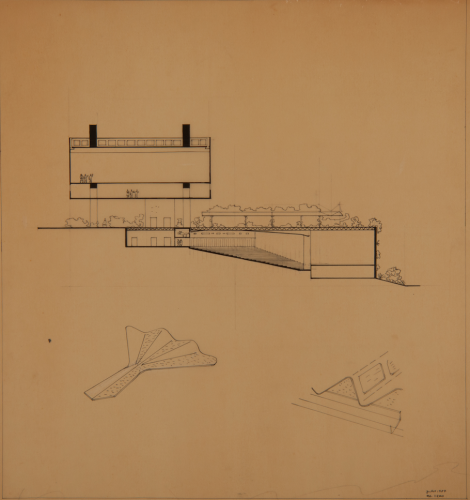
Museu de Arte de São Paulo (MASP), 1957-1968. Section. Picture by Henrique Luz © ILBPMB
In 1957, MASP was in crisis. In an uncertain shot, Lina conceived of a new building for a municipal plot of land on Avenida Paulista, whilst negotiating the future of the museum. A short time later, she accepted an invitation to teach in Salvador and to direct the Bahia Modern Art Museum (Museu de Arte Moderna da Bahia – MAMB), remaining there until the military coup of 1964.
The State of Bahia, of which Salvador is the capital, is part of the northeast region, the first to develop economically during the Brazilian colonization of the 16th century. The emergence of the coffee plantations in the southeast in the 19th century and the concentrated industrialization in São Paulo had displaced the wealth to those regions, leading the northeast to a slow and inexorable impoverishment.
It was in the northeast that Lina encountered the impressive and well-preserved colonial architecture and a population with a strong presence of African descendants. A popular culture with far more intense features than those found in São Paulo, already diluted by industrialization, was to become the centre for a new modernization plan based on the museum and university.
It was a centre with activities that encompassed cinema, theatre and dance, and which included research into the popular culture of the northeast in the various states. On this basis, Lina sought to become linked to the regional development plan for the northeast, promoted at the time by the federal government, in which industrialization ought to have been an evolution based on traditional practices, incorporating the knowledge of the craftsmen in simple manufacture.
Among the various productions towards this goal, Lina developed a modern concept, which aimed at incorporating traditional knowledge. It was not an opposition of the traditional against the modern, but a complementary balance between the two. To this end, she returned to the concept of the MASP museum-school, putting forward the creation of a Popular Art Museum articulated with a Research and Arts and Crafts Centre (Centro de Estudos e Trabalho Artesanal – CETA) and a School of Industrial Design.

Stair perspective – Main exhibition hall. Solar do Unhão, 1959. Picture by Henrique Luz © ILBPMB
In restoring the Solar do Unhão* so that it could host the museum, the shape of the new staircase became the representative image of this project: the spiral stairway within a square, built using a wood construction system of fastening wood with dowels, a technique commonly used in old-fashioned ox carts; thus creating a strong tension between abstract geometry and traditional materiality.
The 1964 coup hit Lina directly: following the invasion of MAMB by the military, Lina resigned and returned to São Paulo, where she would be protected from new challenges. She dedicated herself to building MASP, working until its conclusion in 1968, and deepened her scenography experience, initiated in Salvador. The fruits of her work in Bahia manifested themselves nationally in productions by the young professional visitors to her museums: Glauber Rocha with his cinema; and in music, Caetano Veloso and Gilberto Gil. She also began her collaboration with theatre director José Celso Martinez Correa, for whom she would build the Oficina Theatre years later.
Lina removed herself, without any overt break, from the architects of her generation, coming closer to Joaquim Guedes, who tends to be categorized as Brutalist, and Sérgio Ferro and Flávio Império, engaged in a radical political challenging of the military regime. It was the adoption of a stance in the debate that would question the political and economic support of the Brazilian modern production, both the hegemonic current of Lúcio Costa and Oscar Niemeyer, and the new school of Vilanova Artigas.
A new and broad sector of the Brazilian Left, separated from the Communist Party, advocated the idea of a poor socialism, founded on the basis of direct management of grassroots social groups in opposition to bureaucracy and the technocracy of the national state. Lina’s tuning into that political project was manifested in the work she carried out from the mid-1970s. Her manifestations in a tone of denunciation both of urban planning and industrial design induced a reassessment of her work in Salvador, accentuating the character of an alternative to the hegemonic currents in Brazilian modern architecture, and not the complementarity that used to animate her during her work.
Starting from the plans for the little church of Uberlândia (1976) and the SESC Pompéia (1977), Lina radicalized the stance that she had formulated prior to the military coup. Popular culture came to be filtered by means of a figurative elaboration that appears in her work as an illustrator when collaborating with Gio Ponti, and had ripened through her experience in scenography.
SESC Pompéia is exquisite in this sense. The ambiance of the disciplined work-space of the factory was altered by the creation of scenes, which suggest meanings, which resonate with the experience of regular visitors: the internal street with grass among its cobblestones calls to mind the labourers’ old villages, whilst the huge shed receives mezzanines and furniture, which stimulate the sense of freedom of movement in a factory space.

Early studies - Sheds. SESC – Pompéia Factory, 1977. Picture by Hernique Luz © ILBPMB
In the years following the first stage of the building work, Lina managed the exhibitions, resulting in a remarkable harmony between architecture and space use. However, the radical nature of the cultural project that had animated her activities at MASP and the Bahian museums was out of reach for the institution.
For the new generations that graduated at the beginning of the 1980s, SESC Pompéia indicated a clear alternative pathway to the principles of the schools of Costa and Niemeyer, and that of Vilanova Artigas, even though Lina’s statements avoided any confrontation.
The deep economic crisis that coincided with the downfall of the military regime confirmed that the country had changed, becoming more diverse and complex than in the Brasília years. Architecture would never regain the prominence it had once enjoyed.
Even on Lina’s return to Salvador in 1986 (invited by Gilberto Gil, then Secretary for Culture), her set of interventions would not come close to constituting an articulated plan for real prospects of social transformation, as had happened in the years preceding the military coup.
Most of the proposals for the regeneration of the Historical Centre, such as the maintenance of the original local population and cultural exchange with Benin, have not survived the rotation of elected municipal governments. Among the museum plans, the one that best survived was MASP, which would have its museographic concept suppressed only at the end of the 1990s.
With the exception of the enduring success of SESC Pompéia and some other building works on a smaller scale (including Teatro Oficina), Lina’s production survives only in the form of a reference in the cultural field. The broad dissemination of information that the Instituto Lina Bo e P.M. Bardi has embarked upon following Lina’s death in 1992, has resulted in a growing interest in her work everywhere, including outside Brazil.
What remains to know is what focus this interest will have. In addition to the link between the extreme sociability and architecture of SESC Pompéia, certain aspects of her works’ forms have survived the extinction of the political project that used to animate them. Certainly, her figurative interpretation of the various roots of traditional culture – black, indigenous, mixed race, immigrant – can be fascinating to a world in which it has become increasingly more challenging to live with diversity. However, her approach to such diversity was always aimed at building a national culture, indebted to the concepts of Gilberto Freire’s mixed race and Antonio Gramsci’s hegemony.
‘You can be black, white or yellow, from the North or South, and be national, entering the great international community with original and sacred features of your own country, which deserves your pride.’4
It is with this merit that the oeuvre of Lina Bo Bardi comes to Europe through the Together exhibition.
1 Bardi, L.B., ‘Planejamento ambiental: o “desenho” no impasse’, in Malasrtes, Rio de Janeiro, no. 2, Dec/Feb 1976, pp 4–7.
2 Ibid.
3 Ibid.
4 Bardi, L.B., ‘Uma aula de arquitetura’, in Revista Projeto, São Paulo, no.133, 1990, pp 103–8.
* Translator’s note: Solar is a Brazilian colonial style manor house; Solar do Unhão was named after the 17th-century High Court Judge Pedro Unhão Castelo Branco; it used to be a set of buildings which included a sugar mill.
Translated by © Nadia Kerecuk – Embassy of Brazil in London


