
Articles and Quotes
Beautiful Child (1951) by Lina Bo Bardi
We are publishing this photograph of the Education Ministry in Rio de Janeiro as a call to arms to continue the fight against the formulaic and routine. Make no mistake: formulaic does not just apply to historicism, it also extends (even more dangerously) to the so-called ‘modern’ – modernism as a ‘habit’, as in ‘the old way doesn’t work any more, so let’s move ahead with the times, young men, or we’ll lose out’. We have to fight against this kind of dangerous generalisation, against this devaluation of the spirit of modern architecture, which is unwavering, and shaped by a love of humanity, and has nothing whatsoever to do with exterior forms and formalist acrobatics. The new Brazilian architecture has many flaws: it is young, it hasn’t had much time to stop and reflect, but came into being all of a sudden, as a beautiful child. We can agree that brise-soleil and tilework are ‘intentional elements’, that some of Oscar ), and nor will it be for as long as its spirit is the human spirit and its goal the improvement of living conditions – for as long as it draws its inspiration from the intimate poetry of the Brazilian land. These are the values that define contemporary Brazilian architecture. Its source is not the architecture of the Jesuits: it comes from the wattle-and-daub shelter of the solitary man, laboriously constructed out ...

Lina Bo Bardi in the Frame of Brazilian Architecture by Renato Anelli
Lina Bo Bardi was a member of a professional class of architects who planned and conducted their activities within strategies of political insertion in society. This politicization ought not to be confused with political affiliation, which happened with Oscar Niemeyer or Vilanova Artigas, two great leaders in modern architecture in Brazil, both affiliated to the Brazilian Communist Party. Lina’s politicization presupposes intellectual independence, which would prove incapable of accepting party constraints, despite the fact that she advocated that ‘true liberty can only be collective’.1 The politicization of Lina lies within her quest to occupy a more active stance in the social modernization of Brazil, even though the meaning of this concept radically changed over the 46 years she stayed in the country. This change was made explicit in her 1976 article ‘Environmental Planning: the “design” in the impasse’, in which she denounced (after 30 years in Brazil) the perversity of industrial design and planning in a society of ‘abrupt and unplanned industrialization’.2 She thus consolidates an inflection in relation to her support for the modern plan of national development, based on accelerated industrialization and urbanization (known as developmentalism), which served as a guideline for her work in the first years at the São Paulo Museum of Modern Art (MASP). This inflection is partly due to the Brazilian historical process. When Lina wrote this article, the political movement against the military regime was revisiting the history of Brazil in order to understand the causes of the 1964 coup: a substantial part blamed the developmentalist plan of the 1950s, demanding new political strategies towards a national-popular and democratic plan. Lina intervened in that debate by standing against any romantic stance of nostalgia for the artisan past: ‘Brazil has industrialized; the new reality needs to be accepted so that it can be researched’.3 Thus she ...
Lina Bo Bardi and the Bahian Modern Art Museum: museum-school, museum in progress, by Carla Zollinger
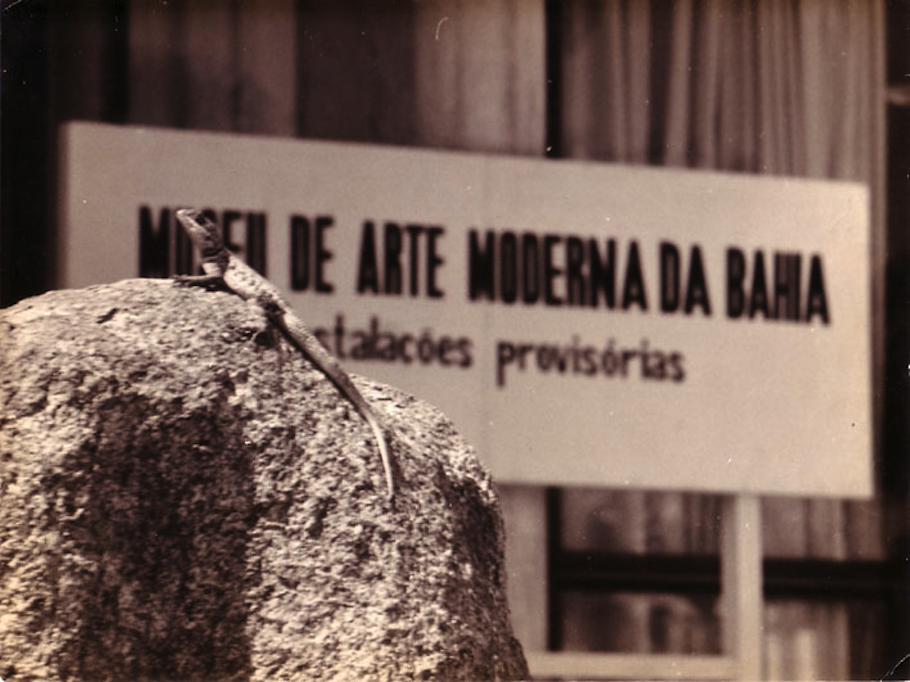
Exhibition of Natural Forms at MAMB. Photo Lenio Braga The Bahian Modern Art Museum (MAMB), set up by Lina Bo Bardi in 1960, was not only conceived as a place to exhibit collections of works: art, objects of everyday use, and natural forms, which Lina assembled herself in the museum. Following its launch, Lina would think of it as a school rather than a museum: ‘… we regard the current meaning of the word Museum inappropriate and attribute another sense to it. The schools that are shortly to be installed in the Modern Art Museum will better define its didactic and useful character.’ Lina Bo Bardi was invited to be the first director of the MAMB in August 1959, by the Governor of Bahia, Juracy Magalhães, and the museum chairperson, Lavínia Magalhães. Lina started her work there in October of the same year, with a conference at the Drama School of the Bahia University, as the museum did not yet have its own premises. In January 1960, Lina inaugurated the museum’s first exhibitions in the temporary premises that she had set up in what remained of the Castro Alves Theatre, which had been partially destroyed by a fire. The use of the museum as a school dates back to its first activities, as Lina stated at its launch in October 1959: ‘… from the Museum-School, attention will be drawn to everything that man represents.’ The running of the museum, associated with the academic year, was analogous to that of a school, including the terminology that was used. The museum was developed within the spirit of didactic ...

Times Of Roughness (II) by Marcelo Suzuki
The following text is part of the doctoral thesis ‘Lina and Lucio’. I worked with Lina Bo Bardi for 11 years. When I finally decided to get my doctoral degree at the University of São Paulo – USP, I thought I should research the work of Lúcio Costa for two reasons: it was too obvious that the Academy expected me to write about Lina, and I wanted a fresh study that would contribute, in the theoretical field, to the most important Brazilian architect of the 20th century: Lúcio Costa. The more I researched, the more I saw Lina’s words in what Lúcio said, and vice versa. To a point where it was just impossible to deny: the doctoral thesis should be called Lina and Lúcio, declining the respectful treatment of referring to them as: Donna Lina and Doctor Lúcio. Although this meeting is about Lina Bo Bardi specifically, I believe it is important for the research regarding her role in Brazilian culture to always be superimposed with the historical and cultural background of the time when she arrived in Brazil: the intellectual environment, the actions of modern architects, and their struggle for the modernisation of the country. Especially Lúcio Costa. How can one explain the longevity of the Minister Gustavo Capanema, at the Education and Public Health Ministry having as his Office Principal the poet Carlos Drummond de Andrade? How can one explain that this very Drummond shared a small room inside the Ministry with Lúcio himself? How to explain that since his youth, the modern Lúcio was the head of the country’s Heritage (IPHAN – Institudo do Patrimônio Histórico e Artístico Nacional)? How to explain that Professor Bardi became the director of the biggest museum of Impressionist art in Latin America because of a ...
The Making of SESC Pompéia by Marcelo Ferraz
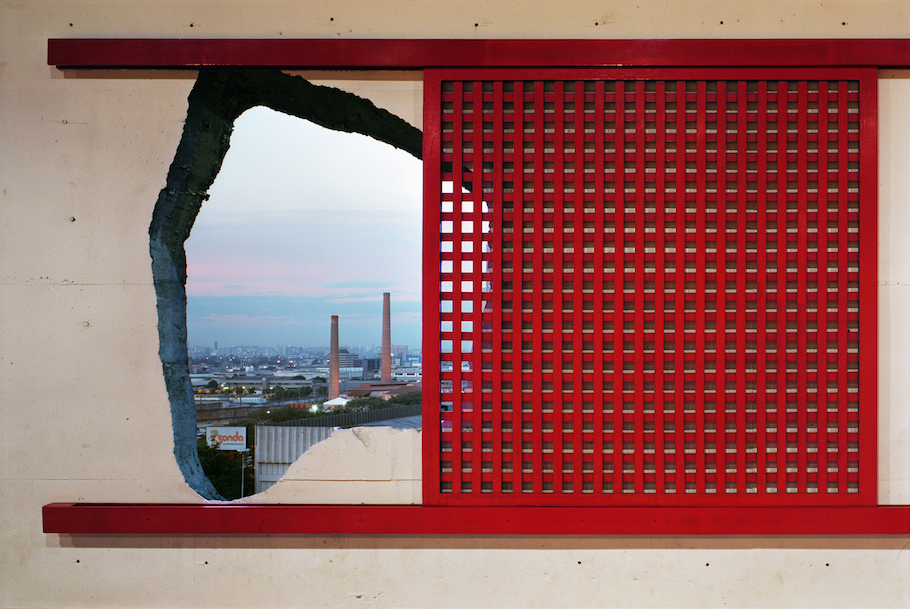
The year 1982 saw the arrival of a new and striking architectural landmark in Brazil, in the city of São Paulo. It was the Centro de Lazer Fábrica da Pompéia (Pompéia Factory Leisure Centre), now known simply as SESC Pompéia. An architectural complex in some ways shocking, combining a red-brick building that had housed a drum factory since the 1920s – well proportioned, in the style of British factories – with three huge and unconventional concrete towers connected by aerial walkways. At that time we were still digesting the modernist project of Brasilia and its aftermath. We were at the end of a 20-year military dictatorship, which contributed to an architectural mediocrity mirrored in works that lay outside our own culture and reality. And it was precisely at this moment, in this environment, that SESC Pompéia arrived, making waves across the still waters. It was a form of architecture that evaded easy classification. Strange? Ugly? Out of scale? Brutal, but also delicate? It was certainly something that seemed beyond the possible universe, unattainable by the hands of contemporary architects. It was a bomb, a shock. It is worth noting that the opening of any SESC (Serviço Social do Comércio – Business Social Service) centre in a Brazilian city represents a significant change to the urban environment, given the facilities for leisure, education and culture that it offers the local population. The SESC is a non-governmental organisation linked to a national business federation, created in the 1940s to provide employees with health services and with sporting and cultural activities. In a way, given the extent of its activities, it has functioned in Brazil as a supplementary culture and sports ministry. But in the case of Pompéia, its influence on the city went even further. Lina Bo Bardi, who had suffered ostracism for almost ten ...


