
Lina Bo Bardi and the Bahian Modern Art Museum: museum-school, museum in progress, by Carla Zollinger

- Exhibition of Natural Forms at MAMB. Photo Lenio Braga
The Bahian Modern Art Museum (MAMB), set up by Lina Bo Bardi in 1960, was not only conceived as a place to exhibit collections of works: art, objects of everyday use, and natural forms, which Lina assembled herself in the museum. Following its launch, Lina would think of it as a school rather than a museum: ‘… we regard the current meaning of the word Museum inappropriate and attribute another sense to it. The schools that are shortly to be installed in the Modern Art Museum will better define its didactic and useful character.’[1]
Lina Bo Bardi was invited to be the first director of the MAMB in August 1959, by the Governor of Bahia, Juracy Magalhães, and the museum chairperson, Lavínia Magalhães. Lina started her work there in October of the same year, with a conference at the Drama School of the Bahia University, as the museum did not yet have its own premises. In January 1960, Lina inaugurated the museum’s first exhibitions in the temporary premises that she had set up in what remained of the Castro Alves Theatre, which had been partially destroyed by a fire.
The use of the museum as a school dates back to its first activities, as Lina stated at its launch in October 1959: ‘… from the Museum-School, attention will be drawn to everything that man represents.’[2] In December 1960, Lavínia Magalhães announced the creation of ‘various art education courses, including an Arts Technical College, which will be a School of Industrial Design focusing upon issues in arts and crafts in the next academic year.’[3] The running of the museum, associated with the academic year, was analogous to that of a school, including the terminology that was used.

The first MAMB premises 1960
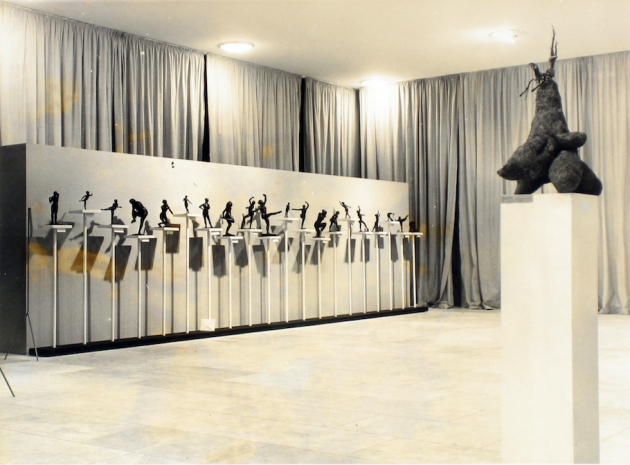
Exhibition of Degas’ ballerinas at MAMB in 1960
The museum was developed within the spirit of didactic equipment, a concept that Lina had evoked in her proposal for an Arts and Crafts and Industrial Art Museum, communicated in the ‘Chronicles on art, history, manners and customs, culture of life’ in 1958,[4] on her first visits to Bahia. The MAMB plan as a ‘museum-school’ in the same way implied an action directed towards practical experience and the traditional trades, as the Governor stated in his address at the launch of the museum: ‘… the education of youth is at the forefront of its work programme. … Here, industrial design will be taught in order to enable artisans and craftsmen and their enterprises to develop their products.’[5]
In Lina’s proposal, the opposition between the museum and the practical worlds of production and industry was transposed: the ‘museum-school’ was a terrain in which craft and art would co-exist. Lina undid the elitist superiority of art in relation to the utilitarian field, and likewise, the primacy of a museum in relation to a school.
The plans that Lina drafted for the ‘museum-school’ were not limited to the School of Industrial Design. As she explained in her first month of work at the museum, in addition to the courses in art, there was also a plan for a course for children,[6] the aim of which was ‘to develop the natural capabilities of creation in the child’.[7]
The didactic spirit of the museum was defined by film director Glauber Rocha in an article published in September 1960: ‘MAMB is not a museum: it is a school in “movement” for an art, which is not detached from man.’[8] He describes the museum in terms of the schools that Lina had developed – the School for Children and the Youth Music School – and those that she intended to build, such as the Schools of Arts and Crafts, Industrial Design, and Industrial Art, which would then constitute a Popular University.
The exhibitions were also aimed at developing this didactic spirit. In the museum, Lina assembled a heterogeneous set, comprising not only works of art, but also nature and art, modern art and popular art, past and present, everyday objects and artwork shown in the Didactic Exhibitions Nós e o Passado (We and the Past), Formas Naturais (Natural Forms), Arte e Técnica: Desenho Concreto (Art and Technique: Concrete Design), and Forma como Escultura (Form as Sculpture), to mention only a few.
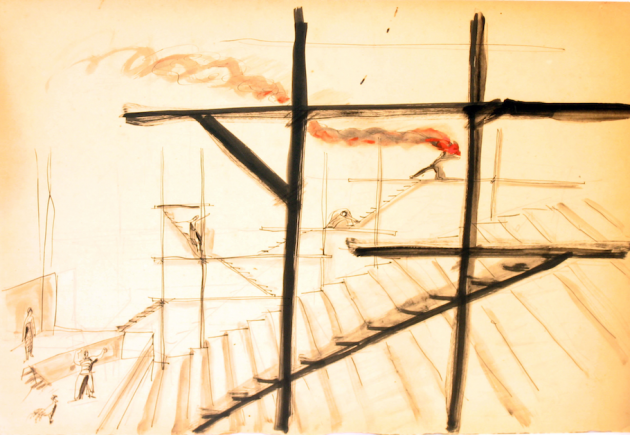
Theatre, dance: didactic use of the museum
The set up of the museum followed the dynamic and didactic character of the museum-school and exhibitions. Lina’s transformation of the Castro Alves Theatre was equivalent to the message conveyed by the objects and natural forms that she had assembled in the Didactic Exhibitions: ‘… to get used to “not throwing away”; not to destroy without thinking.’[9]
The care taken for the surroundings, for nature, and for the work of man, imparted meaning to the building of the museum. Lina endeavoured to build it in the same spirit as the so-called popular or primitive artists, for whom the term building implies using available means and recovering discarded materials.
The installation of the MAMB in the ruined framework of a theatre initiated the action of recycling a pre-existing structure that had been destroyed; recycling the remainders as resources available for that construction; and coming closest to the most essential meaning of the term museum, namely that which overlaps the tasks of assembling, recovering and conserving. The work was identical to that of the primitive artists shown in the Bahia Exhibition, which Lina had staged following her trips to Bahia in 1958, two years before the launch of the museum. The objects that Lina had assembled in those trips, shown in São Paulo – sculptures of ‘remainders’, multimaterial compositions made from paper cut-outs – were, as Lina would define them, ‘precarious architectures’ created with ‘anti-eternal’ materials.[10] In the Bahia Exhibition there was, as Glauber Rocha stated, ‘the Modern Art Museum in potential. It is from this idea that the precariously installed premises at Castro Alves [Theatre] emerged.[11]
The premises that Lina set up at the Castro Alves Theatre depended on the participation of fellow workers in helping to re-use the available resources and the pre-existing space. As Lina herself stated: ‘I have found marvellous collaboration from the workers and from those that work with me, a truly fantastic collaboration. One worker alone made all curtains and so on.’[12] Lina and her collaborators set up the museum in the theatre, following the principles of primitive art, manufacturing with their own hands, using the limited materials within reach of their hands, and finding solutions in something as ordinary as curtains.[13]
The construction of the museum did not start from an exhaustively detailed plan. On the contrary, the documentation that Lina produced was limited to two drawings she made on 18 November 1959, only a month and a half before the installed museum opened its doors to the public.
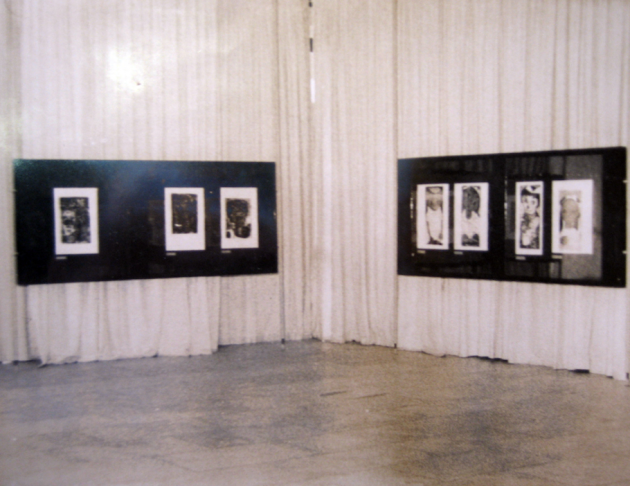
MAMB exhibition room
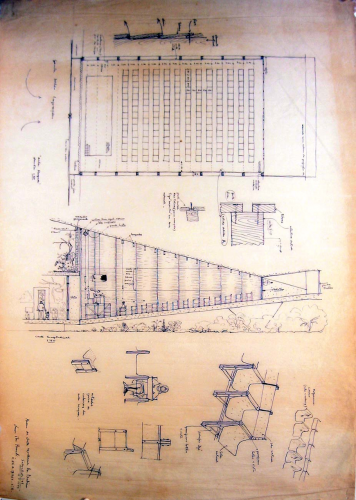
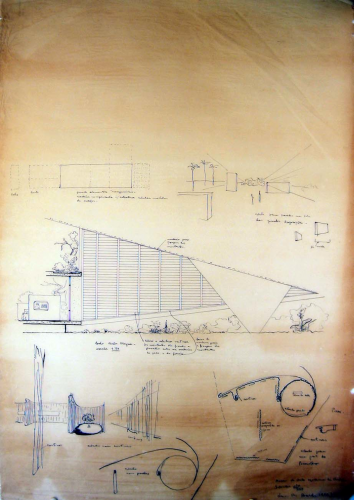 Drawings for the installation of the museum in the theatre made by Lina Bo Bardi on 18 November 1959
In two drawings, Lina identified the available space in the theatre, added the materials that she found to hand – Brazilian ipê boards and slats, natural leather, and brass screws; outlining some of the options to be developed during the construction work, and identifying the design with the re-organization of materials collected, making her architecture coincide – collective architecture as it was – with those scarce resources.
More than a plan, the construction of the museum originated in a ‘movement’, an idea which Glauber Rocha had already expressed in 1960: ‘MAMB is not a museum: it is a school in ‘movement’ for an art, which is not detached from man.’[14] Rather than beginning with a plan, which would bring an idea of future, of projection, of a before and after, the transformation of the theatre into a museum had become an evolving process, ‘in movement’, in progress, under construction.
Like a primitive artist, Lina worked by re-inventing the remains that she found. Just as she built the picture gallery with curtains using the help of collaborative workers, the construction of the auditorium or Aula Magna, located on a ramp (11.5 x 29 m, with access to the audience), was made using the existing space, and identifying the design with it. The sloped configuration of the ramp was propitious for an arrangement of an auditorium, to which Lina added seats adapted to the angle of the floor, with front rests higher than the rear.
‘[The auditorium has] rawhide leather seats and is lined with mats,’[15] wrote Glauber Rocha. As with all the other facilities in the museum, the auditorium was built from the few materials that were readily to hand: ‘natural wood, leather, straw mats; the greatest simplicity; the budget is minimal.’[16] All the elements were built from the same material base: chairs with backs and seats in natural rawhide leather, fastened with brass screws in the ipê slat structure; the frame located in the lowest part of the ramp and the closure of the ramp sides also made with ipê slats and boards; the mats covering the ramp made of straw, thus completing the limited repertoire of raw materials.
The easels that Lina conceived to support the exhibited works – plinths made from an iron bar stuck into a reinforced concrete base – were like the seats of the auditorium and the ‘curtains of thick and cheap cloth’,[17] as mentioned above, made from available materials, many of which were remainders of the reconstruction work of the theatre building, made in a rudimentary workshop ‘set up in the Museum so that the pieces, the furniture, curtains could be made in loco.’[18]
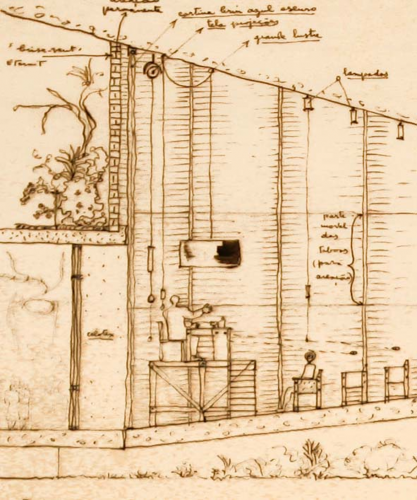
Detail of the cross-section of the auditorium that Lina installed on the access ramp of the theatre
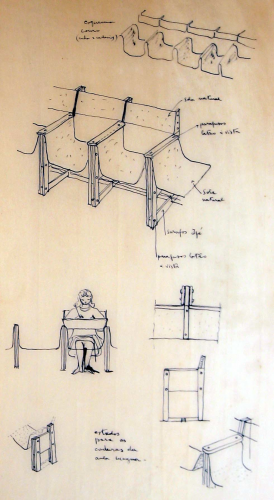
Lina’s sketch (detail) of wood and leather seats for the auditorium
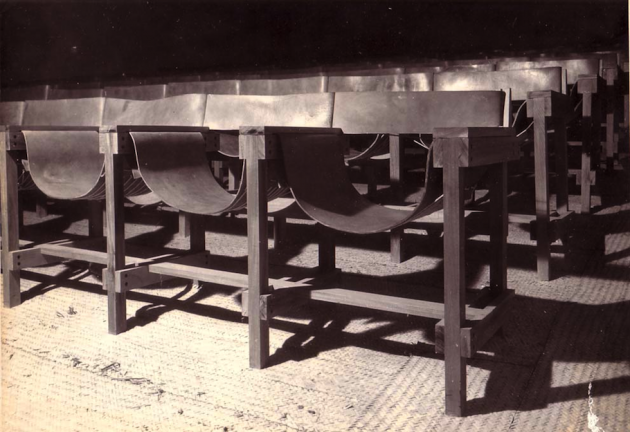
Wood and leather seats for the auditorium
Lina repositioned the building in movement, taking full advantage of its possible use: ‘… at the access ramp to the theatre, we installed an auditorium-cinema for conferences, lessons, projections and debates; in the large underground areas a school for artistic initiation for children; the Drama School and Free Music Seminars of the University also contributed. With Martim Gonçalves, director of the Drama School, on the large semi-destroyed stage, the nakedness of which increased dramaticity, we put on Brecht and Camus: The Threepenny Opera and Caligula. Martim Gonçalves had created a true centre for culture at the Drama School; in Bahia the Cinema Novo movement etched itself; Trigueirinho had just finished shooting Bahia de Todos os Santos in the streets of the city and Glauber launched Barravento at the beaches beyond Itapoã. At the Castro Alves, the young filmmakers used to construct the scenarios with their own hands: A grande Feira, Tocaia no asfalto.[19]
Increasingly, the spaces of the theatre became re-used. In January 1960, Lina occupied the foyer, placing a temporary exhibition area and picture gallery there. In March, she constructed the auditorium or Aula Magna on the access ramp for the audience. In April, she installed the School for Children in the museum; in November, she constructed a ‘theatre of boards’ for the presentation of The Threepenny Opera by Berthold Brecht.
Lina also opened up the museum to the movements that were happening in the city. In 1961, she allowed some of the filmmakers to use the facilities of the museum as a location for their films, as they were creating the first works of the Cinema Novo movement in Bahia.
The guiding principle of the Cinema Novo productions, summed up in the phrase attributed to Glauber Rocha as ‘an idea in the head and a camera in the hand’,[20] coincided with the way that Lina used to work: without a plan, using pre-existing elements such as the work materials, as in the arrangement of the scenarios for the locations of A Grande Feira and Tocaia no Asfalto, executed by the filmmakers with their own hands, as Lina explained.[21]
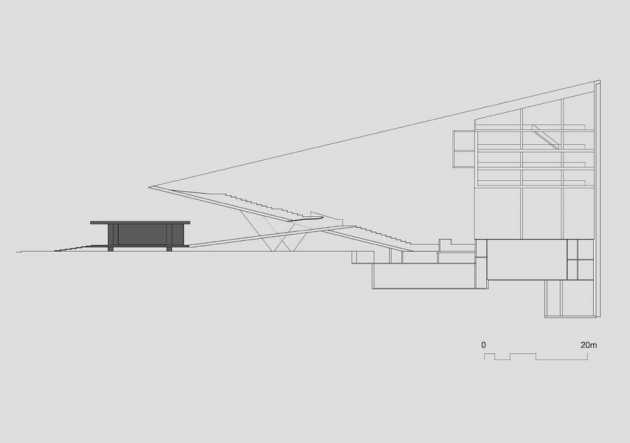

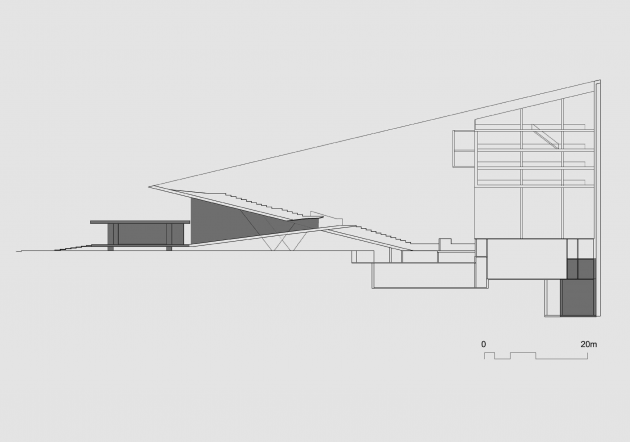
January, March and April 1960. Installation of the picture gallery, ‘Aula Magna’ and School for the Children (reconstruction)
Setting up the museum in the ruins required collective participation, which simultaneously nourished the various forms of expression among all those who were contributing to its creation, making the museum a multiform device under permanent transformation; as a counterpoint to the idea of a ‘petrified museum’, which Lina mentioned in the article ‘Casas ou Museus?’ (Houses or Museums?), published in Bahia in October 1958, in which she stated that ‘the complex problem of a Museum must be faced today on the basis of “didactics” and “technique”. One cannot do without these foundations otherwise one risks falling into a trap by creating a petrified museum, that is, totally useless.[22]
The contrast between museum and house announced in the title of that article was only apparent. In associating the museum as the most necessary building for man, the roles of a house and a museum overlap with one another. A museum analogous to a house was what Lina used to refer to as a ‘vital place’, a ‘living museum’. In the same article, Lina asked: ‘Which come first – Houses or Museums?’ She replied: ‘All at the same time: the houses, the schools, the museums, the libraries.’[23]
The relation between a house and a museum as suggested by Lina conveyed the domestic character of the latter, accessible to all, free, open, so that anyone would feel at home there; confirming the existence of the notion of freedom of expression, action and feeling in the museum, which also was the freedom with which Lina conceived her oeuvre. In addition, the association of a museum with a house implied building with the same domestic ordinary everyday objects loaded with meaning that inhabit a house.
In 1952, when she became jointly responsible with P.M. Bardi for the construction of the São Paulo Modern Art Museum – MASP, Lina referred to the concept of the ‘living museum’ for the first time in her article ‘The living museums in the United States’.[24] In parallel with MASP, the ‘living museums’ identified by Lina in the United States were centres that were open to the community, built collectively, with popular participation, taking on ‘varied activity, multiplicitous, not crystallized in rancid schemes, but entrusted to the inventive spirit, to imagination and experience of man.’[25]
Lina went on to construct the notion of a ‘living museum’, warning that the ‘current museum cannot be a place in ruins, where antique curios are stacked up and where dust prevails like in the catacombs’.[26] All those ideas rooted in the ‘petrified museum’ had to be overcome.

Studies for the stage set of ‘The Threepenny Opera’
However, we ought to understand that Lina did not merely seek play on word oppositions, but to understand why those words were loaded with certain negative aspects. In referring to a ‘location in ruins’, Lina did not want to claim that a ruin was something dead, lifeless, but to contest the belief that the fate of a location in ruins would remain as a pile of antique curios, covered in dust, without any use, with closed doors: dead.
Lina continually inverted the apparent meaning of words: the museum she set up in the ruins of the Castro Alves Theatre was a ‘living museum’; it did not resemble a ‘catacomb’ at all, as the association with ruins might make one think. Recycling dismantled those earlier ideas of ruin as a deposit of antique curios. Lina inverted the meaning frequently given to the word ruin, in the same way that she undid the despicable appearance that the expression ‘memory retreat’ bears: the museum is related to memory, but a memory that is being built, in action, which links past to present.
Eight years after she published those articles about the museum in Habitat, and a decade after the opening of MASP, Lina was to return to the debate on the meaning of a museum in the construction process of MAMB and, before that, in ‘Chronicles on art, history, manners and customs, culture of life’ published in the Diário de Notícias in Bahia, in which she asked: ‘What is a Museum? Usually, when one wants to describe a person, a thing, an idea, as old-fashioned, useless, out of use, there is a habit of saying that ‘they are a museum piece.’
In the process of setting up the museum in the ruins of the Castro Alves Theatre, Lina also inverted the understanding of the meaning of the expressions ‘out of use’ and ‘useless’ by utilising precisely those materials that were apparently ‘useless’ to build the museum.
The remains and left-overs, at first sight ‘out of use’, with which the museum was built, were those that contributed most to the dynamic character of the building work.
Lina’s instrumental universe was limited, created from those ‘useless’ materials, comparable to that bricoleur described by Claude Lévi-Strauss,[27]whose rules of the game are always to use a finite set of instruments and heteroclitic materials, waste from buildings and earlier destructions, as his work is not conditioned by a plan, but it is the contingent result of all opportunities presented to renew or enrich the existing set, or to maintain it by using waste of constructions or earlier destructions.
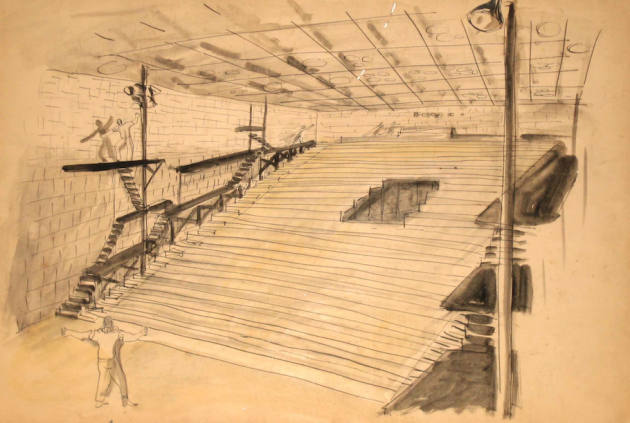
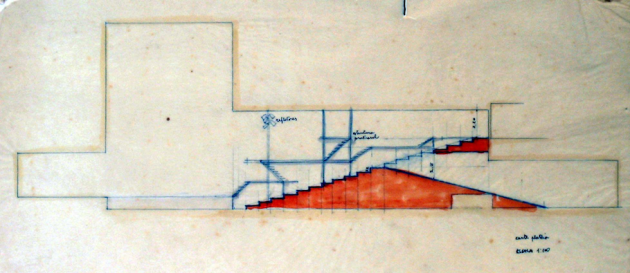
Stage set for ‘The Threepenny Opera’
Analogous to the enterprise pursed by a bricoleur, the heteroclitic set of discarded objects that Lina succeeded in assembling constituted her work material. Construction and destruction waste were akin to raw materials in her architecture. The building of the theatre, half-destroyed, partially under refurbishment, was her source of materials, many of which were detritus that the fire had produced and left-overs of unfinished building work such as iron bars and wooden slats and boards with which Lina and her collaborators built the furniture and facilities of the museum.
For Lina, the expressions ‘recycling’ and ‘reusing’ had a practical justification: comparable to repositioning in movement. The re-use of the theatre was, therefore, a work that repositioned it in circulation, increasingly occupying more of its spaces, opening the museum to the effective participation of the community, in its use as well as in its very building.
Article by © Carla Zollinger
Photos: Museu de Arte Moderna da Bahia – MAMB
Drawings: Instituto Lina Bo e P.M. Bardi; Carla Zollinger
*Translated by © Nadia Kerecuk – Embassy of Brazil in London 2012
[1] BO BARDI, Lina. Museu de Arte Moderna da Bahia, Diário de Notícias. Salvador, 6 Jan 1960.
[2] BO BARDI, Lina. ‘O Museu de Arte Moderna’, Diário de Notícias, Salvador, 18 Oct 1959.
[3] ‘SERÁ inaugurado no próximo dia 6 o Museu de Arte Moderna’ (LAUNCH of the Modern Art Museum on 6th), Diário de Notícias. Salvador, 15 Dec 1959.
[4] BO BARDI, Lina. ‘Arte Industrial’, Diário de Notícias, Salvador, 26 Oct 1958. Crônicas de arte, de história, de costumes, de cultura da vida, no. 8.
[5] MAGALHÃES, Juracy. ‘Museu de Arte Moderna’. [Address of the Governor Juracy Magalhães at the launch of the museum]. Salvador, 6 Jan 1960.
[6] BO BARDI, Lina. ‘O baiano e o museu’, Estado da Bahia. Salvador, 31 Jan 1960.
[7] BO BARDI, Lina [attributed]. ‘A escola da Criança do MAMB’, Diário de Notícias, Salvador, 29 abr. 1960.
[8] ROCHA, Glauber. ‘MAMB não é museu: é escola em “movimento” por uma arte que não seja desligada do homem’, Jornal da Bahia, 21 Sep 1960.
[9] BO BARDI, Lina. ‘Exposição didática da Escola de Teatro’, Diário de Notícias, Salvador, 21 Sept 1958. Crônicas de arte, de história, de costume, de cultura da vida, no. 3.
[10] BO BARDI, Lina; GONÇALVES, Martim. ‘Bahia: Exposição no Parque Ibirapuera. Apresentação’ [exhibition leaflet]. São Paulo, 1959.
[11] ROCHA, Glauber. 1960. [see note 8]
[12] BO BARDI, Lina. 1960. [see note 6]
[13] ‘… the MAMB museographic problems have been solved … by curtains’. BO BARDI, Lina. [Inscription on a photograph of an exhibition of the work of the French painter Georges Mathieu held at the MAMB in 1960, 11th exhibition shown in the museum]. Archives ILBPMB; ROCHA, Glauber. 1960. [see note 8].
[14] ROCHA, Glauber. 1960. [see note 8]
[15] ROCHA, Glauber. 1960. [see note 8]
[16] BO BARDI, Lina. ‘Bahia. Museu de Arte Moderna’, Mirante das Artes, São Paulo, Nov/Dec 1967.
[17] Ibid.
[18] Ibid.
[19] BO BARDI, Lina. ‘Cinco Anos entre os “Brancos”’, Mirante das Artes, no. 6, São Paulo, Nov/Dec 1967.
[20] Even if the phrase ‘an idea in the head and a camera in the hand’ was attributed to Glauber Rocha, who was the main filmmaker, as well as the main theoretician, of that movement, the filmmaker Paulo César Sarraceni reclaimed it. However, J.C. Teixeira Gomes warned all that it would not be a surprise if the authorship of that maxim were shared, since that concept was common currency in the movement. GOMES, J. Carlos Teixeira. Glauber Rocha, esse vulcão. Rio de Janeiro: Nova Fronteira, 1997, p. 146.
[21] BO BARDI, Lina. 1967. [see note 20]
[22] BO BARDI, Lina. ‘Casas ou Museus?’, Diário de Notícias, Salvador, 5 Oct. 1958. Crônicas de arte, de história, de costume, de cultura da vida, no. 5.
[23] Ibid.
[24] Lina was the author of various articles published in this issue of the magazine Habitat, which she directed from issue nos. 1 to 9.
[25] BO BARDI, Lina. ‘Os museus vivos nos Estados Unidos’, Habitat, n. 8, São Paulo, Jul/Sept. 1952, pp. 12-15.
[26] BO BARDI, Lina. ‘Balanços e perspectivas museográficas: um Museu de Arte em São Vicente’, Habitat, no. 8, São Paulo, Jul/Sept. 1952, São Paulo, pp. 2-5.


