
Times Of Roughness (II) by Marcelo Suzuki
The following text is part of the doctoral thesis ‘Lina and Lucio’.
I worked with Lina Bo Bardi for 11 years. When I finally decided to get my doctoral degree at the University of São Paulo – USP, I thought I should research the work of Lúcio Costa for two reasons: it was too obvious that the Academy expected me to write about Lina, and I wanted a fresh study that would contribute, in the theoretical field, to the most important Brazilian architect of the 20th century: Lúcio Costa.
The more I researched, the more I saw Lina’s words in what Lúcio said, and vice versa. To a point where it was just impossible to deny: the doctoral thesis should be called Lina and Lúcio, declining the respectful treatment of referring to them as: Donna Lina and Doctor Lúcio.
Although this meeting is about Lina Bo Bardi specifically, I believe it is important for the research regarding her role in Brazilian culture to always be superimposed with the historical and cultural background of the time when she arrived in Brazil: the intellectual environment, the actions of modern architects, and their struggle for the modernisation of the country. Especially Lúcio Costa.
How can one explain the longevity of the Minister Gustavo Capanema, at the Education and Public Health Ministry [which, by the way, has a very suggestive name] having as his Office Principal the poet Carlos Drummond de Andrade? How can one explain that this very Drummond shared a small room inside the Ministry with Lúcio himself? How to explain that since his youth, the modern Lúcio was the head of the country’s Heritage (IPHAN – Institudo do Patrimônio Histórico e Artístico Nacional)? How to explain that Professor Bardi became the director of the biggest museum of Impressionist art in Latin America because of a chat at a vernissage? And what about Lina receiving permission from the head of the Legacy to create the Solar do Unhão? The answers to these key questions will help us to understand Lina’s role within the overview of Brazil.
The architects Lina Bo Bardi and Lúcio Costa had a very particular vision of Brazil, characterised by a complete absence of any inferiority complex. They were both born in Europe. He was from a Brazilian family, but born in France. She was born in Italy, but Brazilian ‘by adoption’ – which meant being even more Brazilian, for her. They were Brazilian in their manners, but by preserving some kind of foreignness – oddness – were able to maintain the intransigent state of judgement spoken of by Le Corbusier.
In every attitude, and all the time, they preserved their roughness. The expression is difficult to understand even in Portuguese, but I will try to clarify it through this text.
There is an inferiority complex below the Equator line. A complex of mongrel dog and of the ‘Yes Sir!’ current in all Brazilian literature, from newspapers to academic essays – and notable in the works of Nelson Rodrigues. It’s the admiration for what comes from outside, for the foreign: either what is imported is far better, or the reaction against it doesn’t create any new proposal. It merely denounces a poorly hidden discourtesy.
Apparently, this complex has been decreasing, but it still counts as a warning lesson, beautiful child. Lina and Lúcio always saw things from a point of view distant to this one. They saw the behavior of the common people as completely different from that of the middle class, which had already exchanged the ‘cordial man’ for a politically correct one.
Sérgio Buarque de Holanda, writing in the 1930s and 40s, explained his vision of the genuine Brazilian man:
… the cordial man – expression created by Ribeiro Couto – the frankness of treatment, the hospitality, the generosity, but also the animosity and other similar manners, as long as they belonged to his heart. The cordiality has nothing to do with proper manners, politeness or courtesy. The demonstrations of the cordiality are expressions ‘of an emotional depth that is rich and overflows’. The civility, on the contrary, deals exactly with controlling and hiding the emotions, thanks to the subordination of behavior to rules expressed in orders and commandments.
It is precisely this cordial man that delighted Lina from the very first moments she spent in Brazil:
When I arrived in Brazil I was astonished. The people were impertinent, ordinary, wonderful…. I found once again the hopes of the war nights. I was happy and there were no ruins in here. And further on, the people were naughty, elegant, what was their place?
Lúcio writes:
In Brazil, since 1500 until the end of the 19th century, every single labor force was slave.
Although slavery was legally abolished, the workers from the countryside and the cities kept considering themselves inferior to the bourgeoisie. Only after 1930, with the creation of The Ministry of Labor, they realized they had rights and started to demand them. … Brazil will never be an average commonplace.
He continues:
Geographically, historically and socially Brazil – even because of its dimensions and this problem of slavery of the black people – corresponds symmetrically in the South to the United States in the North, while Argentina, Chile and Uruguay would correspond to Canada and the other pre-Colombian countries to Mexico.
He expands on this in another text:
The New World is not in this side of the Atlantic Ocean anymore, nor it is on the other side of the Pacific. The New World is not on our left or right, but above us – we need to raise our spirits in order to reach it, because it is no longer a matter of space, but a matter of time, evolution and maturity.
Lúcio then recommends the following:
Assume and respect our original ballasts – Portuguese, African and native.
Recognize the great importance of the European migration – both Mediterranean and Nordic - for today’s Brazil, as well as the Asian migration – both near and faraway.
Welcome as legit and fertile the results of these meshes, and take them in consideration for our peculiar and distinctive – Brazilian [Lúcio’s emphasis] – behavior.
Preserve and cultivate these distinguish and original characteristics.
Refuse any kind of subservience, including the cultural, but absorb and assimilate foreign innovation.
To absorb and assimilate foreign innovation was gratefully preceded by Oswald de Andrade in his Anthropophagic Movement. Even Le Corbusier felt it:
… The young people from São Paulo exposed me to their thesis: ‘we are anthropophagi’. The anthropophagy was not a voracious tradition. It was an esoteric ritual of communion with the best of the forces. The repast was shared with parsimony between one to five hundred people who were willing to eat the flesh of the captured enemy. This warrior was precious because the tribe would incorporate his virtues and he himself had eaten the flesh of the warriors from the tribe before. Thus, by eating that meat they were assimilating the flesh of their own ancestors.
We relate this to a ‘chorinho’, a form of traditional folk music from Brazil:
Mix it and Down it, is a song, a ‘chorinho’. The ‘choro’ – literally ‘weep’ – is a rhythm almost always fast (even the lyrics, when present, are difficult to catch), joyful and playful and full of brakes and off-beats … Pixinguinha exchanged music scores with Duke Ellington by mail.
Pixinguinha didn’t speak English, Sir Duke didn’t speak Portuguese: they’d understand each other through the scores and notations.
Mistura e manda is also a popular saying that assigns the Brazilian way of eating, rice and beans with wheat flour and dry meat: you mix everything and eat it and, when said, it is associated with the act of carrying the fork to the mouth with an insolent gesture. The ‘mix’ is also the most expensive part of the recipe: rice, beans and wheat flour are the basis; the meat – cow, chicken or goat – is the mix.
In this regard, Lina did the same synthesis, mixing roughness and insolence with freedom and elegance: rejecting any contradiction and highlighting their complementarities:
The West is at the edge of a complete revision. I don’t believe Brazil is part of the West. It is Africa! Thank God Brazil is out of the West, the poor West. The West after World War II is lacking. Everything that once was elegance, refinement, full of tasty things… is gone. These cannot and should not be seen as roughness but as moral misery.
Lina would always tell the story of how there were mutinies in the first ships that arrived with immigrants from Italy. They thought they had been deceived by the agents and sent off to Africa: from the ship, what they could see at the Port of Santos where they would land was only black people, all the dockworkers… [this line is quoted from memory]
Also, in Progress and Civilization:
What mankind conquered through time was progress. Civilization survived endangered. … What the West has been doing, rigorously, until the present day is … to detach Progress from Civilization; something that didn’t happen in the East … anyone who travels from the Americas to the Far East feels on the vast horizons the stillness of Nature (illusory stillness. It’s an earthquake land). The choice for Progress of the West is not the only existing way; other options could have been chosen with the same results. The option made by the West achieved powerful results, but with tremendous costs.
Specifically regarding Brazil:
How is Brazil to a European who lands for the first time in Rio de Janeiro? From airplane, the contrast of the favelas and the modern buildings leads more to a social chaos than to the bourgeois eager for the standardized sky-scratcher, instead of the style-house. From ship, Copacabana bay and the Ministry of Education, along with other buildings, suddenly appear, almost stuck to the forest that exhales the smell that comes aboard. These suggest a human effort that doesn’t leave time to think what would be better, if the sky-scratcher or the Portuguese folk house.
Lúcio, in turn, describes his ‘discovery’ of Brazil through a child’s eyes:
I only took note of Rio de Janeiro when I was fourteen. Being born outside I was brought there with only a few months of living, but my parents returned in 1910 – England, France, Swiss – and there we stayed until the end of 1916. Therefore, the definitive return was a revelation to me: the peculiar mountains, the woods, the houses, the close sky, the sea. Then the seashore, the undertow, the ‘surf’ – this immemorial meeting of wave and beach – it was a show that would take your breath out.
Destiny, however, the fortune wheel, wanted Lina to come to São Paulo:
1947: Chateaubriand [Assis Chateaubriand, Brazilian lawyer, journalist, politician and diplomat] invites Pietro to establish and manage a Museum of Art in Brazil: in Rio or São Paulo. I was hoping for Rio, but the money was in São Paulo. I told Pietro I wanted to stay, that I had found again in here the hopes of the war nights. Thus, we stayed in Brazil.
So reports the Professor [Pietro Bardi]:
But the Promoter [Assis Chateaubriand] kept in doubt: where to establish the Museum? There were two options: Rio de Janeiro or São Paulo. The indecision went on until he confessed his preference for the land that produced the richness of that time: the coffee. We ended up ‘paulistas’ [São Paulo dwellers].
The Professor narrates his meeting with Chateaubriand [these words are quoted from memory]:
We boarded in 1946 on the ship Admiral Jaceguay, bringing with us [Pietro and Lina] the artwork. At the capital we were met with an old friend, Mário da Silva, Brazilian journalist…. We were lucky to have his help, gain the ballroom of the Ministry of Education and Health, where I was able to present the two collections I had brought and whose catalogue he translated.
It was there I got to meet Assis Chateaubriand, one of the first visitors and very interested in old paintings, having bought four of them. Mario [Mario da Silva] already knew that visitor and quickly told me about his life … recommending me to ‘stare attento’ [pay attention] … As we spoke, Chateaubriand told me of his intention of creating a Museum in Brazil.
Would this have been the first contact between Lina and Lúcio? The Professor told me about the following dialogue that occurred that day with Chateaubriand:
Bardi – I was told that you are an adventurer.
Chateaubriand – Yes, indeed.
Bardi – Good! Because I am an adventurer myself…
They remained friends, living ‘fable stories’ throughout their lives.
Bardi had no fear of controversies and went through a lot of them. So did Chateaubriand. And also Lúcio and Lina, for different reasons but with ‘convergent results’, for trying to demonstrate all the time the importance and the range of the Architecture, the public and intellectual role that the architects have to fight for, ‘spitting their reasons’.
They were prevented from having an academic career in the universities. Still, they kept being professors all the time, ‘for architects write: they register their memorials to introduce and clarify their own works, manifestos to mark their positions to other architects, to praise or depreciate the architectures from other times…’
Lina quoted Brazil Builds many times, as an announcement of something sui generis in comparison with the ‘known’ world, the ‘cultured West’, as a publication that had ‘changed everything’.
Documentation of the ahead: the book of the Museum of Modern Art, Brazil Builds, a hope that is real and almost usual, not metaphysical, found in the simplicity of the architectural solutions, in the human “halloos”, unknown things for a generation coming from faraway. By then, straight after war, it all seemed as a lighthouse shinning in the middle of a death field… It was something wonderful….
Both Lina and Lúcio gave a lot of importance to the everyday doing of the common workers from all the origins that, blended here in Brazil, left a special heritage of what existed in terms of simplicity and ‘poverty’. And they were clear in what they meant by that: the opposite of the pseudo-refinement of the rich houses.
Lúcio remarked in his Reports of 1937, the efficient handcraft of the Guaraní people in the intricate making of the ornaments ‘required’ from them. In several other moments he would return to this topic of how people made things, either these or the Portuguese master builders, for instance.
Since Precisions, Le Corbusier had also registered the architectural qualities of the back (rejecting the adorned fronts) of the houses built by an Italian contractor in Buenos Aires:
They have a standard plan, a pattern of beautiful shapes under Argentinean light, a game of really pretty shapes, really pure. Look at it! Measure the scandal of these English cottages with their tiled roof, useless, with rooms in the mansards, demanding annual expenses for their maintenance. These gentlemen gave birth to the terrace-roof in Argentina….
Lina’s point of view on the pre-handcraft meant demonstrating the intelligent creativity used to overcome necessity, in a way that revealed a new Brazilian way. Lina refuted the position of contemporary industry, where the product’s obsolescence was replaced by the expendable in the consumption of inutilities.
In this praise of genius, Flavio Motta said:
The oil lamp made of an electric lamp was no use for the consumer of ‘oil lamp’ as a lamp. It was there only as a glass reservoir. It had lost its signification as electric lamp. The consumers of the electric lamp didn’t know what do with it and threw it away. The inventor of the oil lamp, who didn’t know what to do with the lamp as an electric lamp, figured out how to create another signification to it. He had the intention that his work – the oil lamp – was appreciated, respected, used and consumed – at least as the result of his activity in organizing a small universe of pieces, aligned to the everyday life’s demands, in a poor environment, still having the necessary creativity. It doesn’t exalt an aesthetics of poverty, an aesthetics of garbage, which the ‘third worldism’ [terceiro mundo, terceiro mundismo] likes so much. It only shows that the range of some ways of organizing the distribution, the production and the consumption not always reaches all the population. That asserts the human capacity of the in spite of. It doesn’t justify the poverty, the incapability or the impossibility of a work socially necessary.
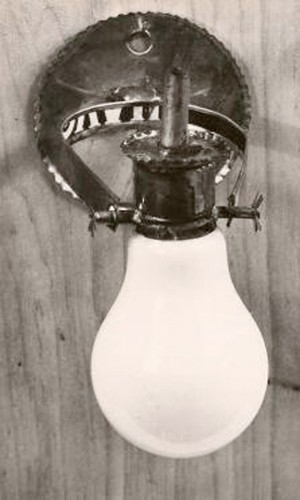
Figure 1. Fifó, candeeiro, lamparina
[wall light]. Made from a burned electric lamp
and old tin cans. This model has multiple uses.
At the stand of Brazil in the XIII Triennial of Milan in 1964, Lúcio made this appealing project:
It will be enough for us to exhibit a living room atmosphere, ‘furnished’ only with hammocks – about 14 – and some of the simplest guitars, an environment destined to receive the weariness of the visitors in the exhibition. Its disposition will make everyone curious … green bold letters will invite the visitor to rest: RIPOSATEVI.

Figure 2. XIII Triennial of Milan, 1964, pages from the catalogue. Photos by Marcel Gautherot.
In the Triennial, Lúcio exhibited hammocks that were there to be used, not to be observed, and he insists – encourages – this with the big lettering: it is there to be used – to take a rest, and the guitars to be played. We could blend this proposition with another of Lúcio’s collocations:
Restez chez vous – Stay where you are. The construction of Brasilia in the middle of the desert, a thousand kilometers from the coast, at first provoked, a general feeling of fondness for the foreign, even more because of its stripped architecture, graceful and innovative, almost uncommon, marveling everybody.
Next, they started to depreciate the city, accusing it of being a lost opportunity because – among other issues – the population was poorly accommodated. As if by a simple transference of capital the urbanism could resolve all of the bad habits of centennial economic and social reality …
Lina and Lúcio established architectonic programs or interfered in necessity programs that were provided for them.
Lina determined how people should use the spaces she planned, in the relation between furniture and objects projected for that space, and in the relation between them and the users. The SESC – Factory of Pompéia and the MASP (Museum of Art of São Paulo) are good examples of this application.
Lúcio also established contents. In the plan for Monlevade there are several examples of extrapolation of the established programs in context, including drawings of scenes showing the behaviour of the people in the design.
In Brasília, these extrapolations are given impressive details, the contents of each place specifically explained, complete with their baptism names and even addresses. For instance, N-Q3-L ap. 201. Or even the Three Powers Square, contribution of Oscar Niemeyer for the square I planned – and named.
Lina and Lúcio: they fought a lot, had a lot of luck, but also discontents. They reacted and carried on. They left a wonderful legacy of sayings, writings, drawings and constructions with the firm vehemence of remarked [experienced] authorities in the matter of their craft: Architecture.
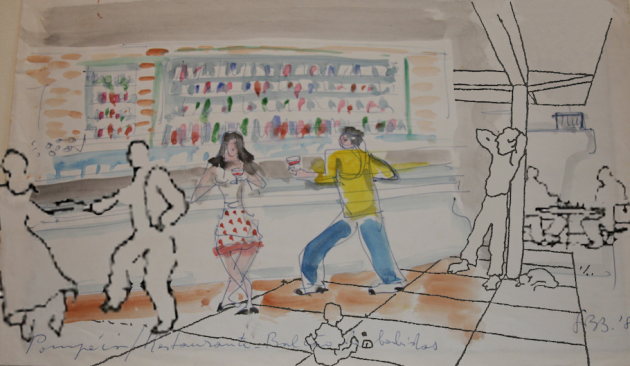
Figure 3. Drawing of Lúcio for Monlevade, 1934. Overlapped with a drawing of Lina for the SESC – Factory of Pompéia, 1979.
1 SUZUKI, M. (ed.), Times of roughness: the stalemate design, São Paulo: Lina Bo e P. M. Bardi Institute, 1994. (II) is an interpretation by the author.
2 Gustavo Capanema was the Minister of Education and Health from 1930 to 1945. He was surrounded by intellectuals and artists, including: Carlos Drummond de Andrade, Mário de Andrade, Cândido Portinari, Manuel Bandeira, Heitor Vila-Lobos, Cecília Meireles, Lúcio Costa, Vinícius de Morais, Afonso Arinos de Melo Franco and Rodrigo Melo Franco de Andrade.
3 LE CORBUSIER, Precisions: On the Present State of Architecture and City Planning
4 Nelson Rodrigues (1912-1980), important dramatist, writer, journalist and critic of the Brazilian traditions.
5 COSTA, L., Record of an existence, São Paulo: Empresa das Artes, 1995, p. 169.
6 Ibid.
7 SALLUM Jr., B., Sérgio Buarque de Holanda: Roots of Brazil, in MOTA, L.D. (ed.), Introduction to Brazil: A banquet at the tropics, São Paulo: Editora SENAC, 2004, p. 251.
8 FERRAZ, I.G. and MICHILES, A., Lina Bo Bardi, documentary in VHS, Lina Bo e P. M. Bardi Institute, São Paulo, 1993.
9 COSTA, L., ‘Options, recommendations and messages’, in Record of an existence, op.cit. p. 382.
10 Ibid.
11 COSTA, L., Record of an existence, p. 379, originally published in the MÓDULO MAGAZINE, No. 93, article by Arnaldo Carrilho.
12 COSTA, L., With the Word, Lúcio Costa, COSTA, Maria Elisa (ed.), Rio de Janeiro: Aeroplano, 2000, p. 158.
13 LE CORBUSIER, Precisions: On the Present State of Architecture and City Planning, São Paulo: Cosac & Naify, 2004, p. 29.
14 NELSON ALVES, ‘Mistura e manda’, in PAULO MOURA. Mistura e manda, Rio de Janeiro: Kuarup Discos, 1986.
15 MONTEZUMA, R. (ed.), Architecture Brazil 500 years, vol. 2, Recife: Universidade Federal de Pernambuco, 2008.
16 BARDI, L.B., Lina Bo Bardi, FERRAZ, M.C. (ed.), São Paulo: Lina Bo e P. M. Bardi Institute, 1993, p. 203.
17 Ibid p. 209.
18 Ibid p. 12.
19 COSTA, L., Record of an existence, op.cit. p. 371.
20 BARDI, L.B., Lina Bo Bardi, FERRAZ, M.C. (ed.), São Paulo: Lina Bo e P. M. Bardi Institute, op.cit. p. 12.
21 BARDI, P.M., History of MASP, São Paulo: Quadrante Institute, now Lina Bo e P. M. Bardi Institute, 1992, p. 11.
22 BARDI, P.M., ibid p. 10.
23 COSTA, L., With the word, Lúcio Costa, op.cit. p. 23.
24 LEONÍDIO, O., Spitting Reasons: Lúcio Costa and the modern architecture of Brazil, Rio de Janeiro/São Paulo: Ed. PUC-Rio, Loyola, 2007.
25 RUBINO, S., The writing of an architect, in GRINOVER, M. and RUBINO, S., Lina by writing – selected texts of Lina Bo Bardi, São Paulo: Cosak & Naify, 2009, pp. 20, 21.
26 GOODWIN, Philip L., Brazil Builds Architecture New And Old 1652-1942, New York: The Museum of Modern Art, 1943.
27 BARDI, L.B., Lina Bo Bardi, FERRAZ, M.C. (ed.), op.cit. p. 12.
28 COSTA, L. Necessary Documentation – 1938, in Record of an existence, São Paulo: Empresa das Artes, 1995, p. 462.
29 LE CORBUSIER, Precisions: On the Present State of Architecture and City Planning, op.cit. p. 222.
30 MOTTA, F., Textos informes (Report texts), São Paulo: FAU-USP, 1973, p. 3. The word informe means both advice and report, as well as shapeless and formless.
31 COSTA, L., Record of an existence, op.cit. pp. 408, 409. Riposatevi is Italian for ‘rest’.
32 COSTA, L., Record of an existence, op.cit. pp. 314, 315.
33 Ibid p. 294.
34 Ibid p. 306.


